Recently, Prof. Yang Gan's group at our school, in collaboration with Prof. Shuaifeng Lou, Prof. Chunyu Du, and Senior Engineer Dan Zhang, published a review article entitled "Reticular framework electrolytes for liquid-free all-solid-state sodium batteries: design principles and evidence standards" in Journal of Materials Chemistry A (JMCA), a leading journal in materials chemistry. The article systematically reviews advances in reticular framework solid electrolytes for all-solid-state sodium batteries and proposes a key conceptual framework and design principles, providing an important reference for moving this research toward practical applications. The first author is Yining Lv, a 2023 doctoral student of our school (supervised by Prof. Yang Gan), and the corresponding author is Prof. Yang Gan.
All-solid-state sodium batteries are promising candidates for large-scale energy storage because of their cost and safety advantages. However, the meaning of "solid-state" in the current literature remains ambiguous, and a unified evaluation standard criterion for the degree of liquid involvement is lacking, which seriously restricts the comparability and reproducibility of reported findings. Meanwhile, reticular framework materials, including metal-organic frameworks (MOFs), covalent organic frameworks (COFs), and hydrogen-bonded organic frameworks (HOFs), have attracted considerable interest as building blocks for emerging solid electrolytes because of their programmable pores and tunable coordination chemistry. However, thoughhavinggood ionic conductivity, their integrated roles in sustaining continuous Na+ migration, achieving selective transport, and stabilizing solid-solid interfaces have not received sufficient attention.
To address these key issues, the review advances five propositions:
First, an ionic-liquid involvement index (ILI) is proposed to define the boundary of truly liquid-free all-solid-state systems.
The index classifies systems into three levels: ILI-0 (genuinely liquid-free), ILI-1 (dry-assembled but containing residual liquid), and ILI-2 (dependent on liquid-assisted processing). By linking the history of liquid use, residual-liquid detection, and cell performance, this classification provides a unified conceptual framework for comparisons across different systems.
Second, the design of reticular framework materials is re-examined: they are not merely inert fillers, but spatial programmers of Na+ migration.
The article argues that, from the broader perspective of rational reticular framework design, these materials should not be regarded simply as inert fillers. Rather, they should serve as spatial programmers of Na+ transport. Through rational design, framework materials can create continuous, low-tortuosity Na+ percolation pathways at both the pore and membrane scales , rather than serving merely as passive fillers.
Third, a shift in the design philosophy of composite-electrolytes is promoted from increasing conductivity to reconstructing charge carriers and solvation environments.
Reticular framework materials can weaken Na+-anion association by immobilizing or trapping anions. They can also compete with polymer coordination sites to alter the Na+ coordination shell, thereby dynamically regulating the capture and release of charge carriers.
Fourth, the continuity of interfacial pathways is emphasized as the key to stable operation of liquid-free batteries.
The article summarizes interfacial design strategies such as MOF epitaxial layers and composite interlayers, describing them as "topological wiring elements". It explains their important roles in facilitating ion transport across solid-solid contact regions, locally anchoring and redistributing ions, and accommodating interfacial stress.
Fifth, minimum evidence and reporting requirements to make results reproducible and comparable results are proposed.
To address poor reproducibility in the field, the authors recommend that researchers provide a complete chain of evidence, including key characterization data on filler dispersion and compatibility, pore filling and connectivity, densification and grain-boundary porosity, the evolution of interfacial impedance, and the uniformity of ionic flux.
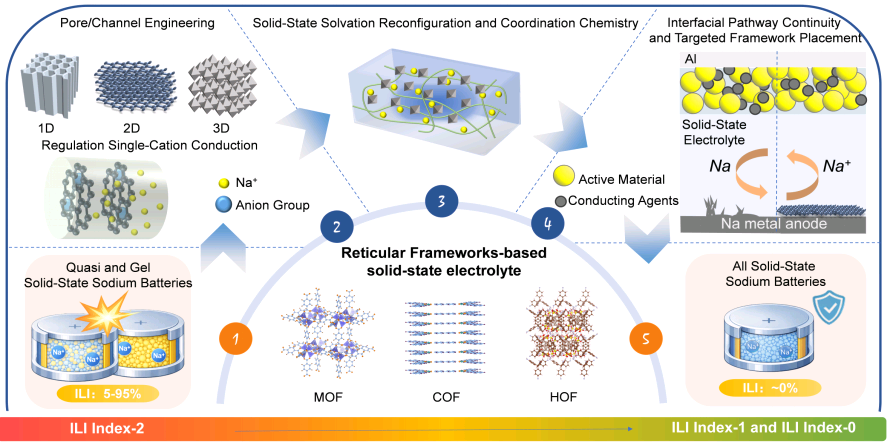
Figure 1. The ILI index defines system boundaries and supports design guidelines for reticular framework electrolytes by comprehensively considering the coordinated regulation of Na+ transport, solvation, interfacial continuity, and other factors.
The article concludes that reticular framework electrolytes could achieve genuine practical application if the field advances beyond its early focus on structural concepts toward a new stage featuring rational design, clear mechanisms, and rigorously verifiable results.
Article link: https://doi.org/10.1039/D6TA05706C
[Author Information]

Yining Lv is a doctoral student (Class of 2023) at the School of Chemistry and Chemical Engineering, Harbin Institute of Technology. Her research focuses on interface modification of all-solid-state metal batteries, with particular emphasis on the synthesis of novel MOFs and their application in solid-electrolyte preparation and interface layer modification. She has published several papers in journals including Energy Storage Materials, Journal of Materials Chemistry A, and Sensors and Actuators B, and received the Best Poster Award at the 4th Symposium on Electrochemical Energy Conversion of the Chinese Chemical Society in 2026.

Yang Gan is a professor and doctoral supervisor at the School of Chemistry and Chemical Engineering, Harbin Institute of Technology. His long-standing research interests include surface and interfacial physical chemistry, electrochemical surface engineering, new-energy materials, and electrochemical energy storage. His work focuses on materials and mechanisms for lithium/sodium-ion batteries and all-solid-state batteries, as well as graphene nanomaterials and electrochemical processing of complex structures. He currently serves as a council member of the Chemical New Materials Committee of the Chemical Industry and Engineering Society of China, a core member of the Compound Semiconductor Standards Technical Committee of Semiconductor Equipment and Materials International (SEMI), a senior member of the Chinese Chemical Society, and a council member of the Heilongjiang Society for Electron Microscopy. He was elected a Fellow of the Royal Society of Chemistry (FRSC) in 2015. Since 2021, he has served as a member of the second Academic Committee of Harbin Institute of Technology and as a university supervisor of graduate teaching. He authored the book Writing Methods and Techniques for Graduate Thesis Proposal Reports (Harbin Institute of Technology Press, August 2022, third printing forthcoming).