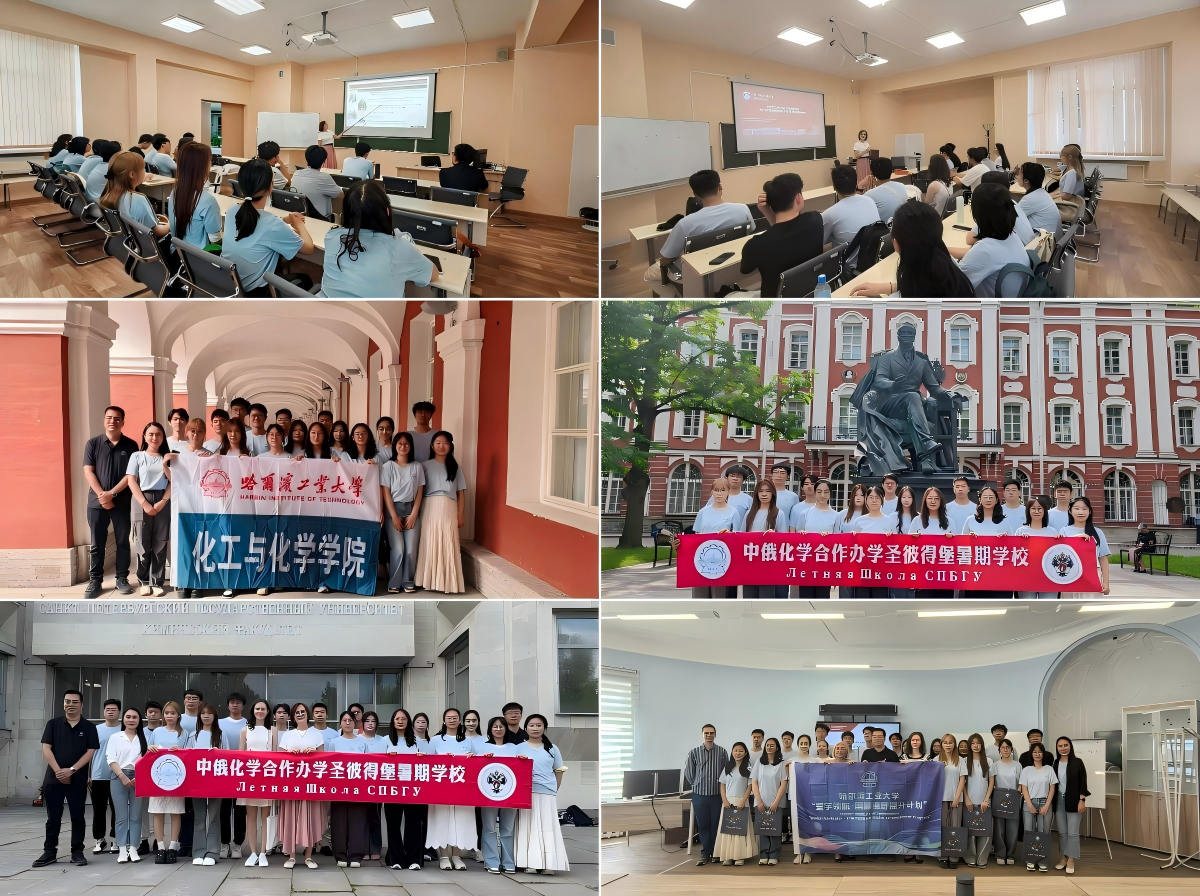
To broaden students' international perspectives, strengthen their cross-cultural communication skills, and deeply engage with the high-quality faculty and frontier research resources of the Russian partner university, the School of Chemistry and Chemical Engineering organized 17 students from its Chemistry (Sino-Foreign Cooperative Education Program) to attend a two-week summer school at Saint Petersburg State University beginning on August 2. The study delegation was led by Guolin Gao, Jing Wang, and Wenbo Wang.
Each morning, the summer school offered systematic coursework delivered by the experienced faculty members at Saint Petersburg State University. The courses covered general language skills, including everyday communication and situational dialogue, while integrating Russian art history, urban culture, and chemistry. By integrating general education with disciplinary learning, the program helped students deepen their understanding of Russian cultural traditions, the history of scientific research at Saint Petersburg State University, and current frontiers in chemistry. This foundation prepared them for the field visits that followed and allowed them to apply classroom learning to extend effectively into real-world settings.
On-site study in the afternoons served as an important extension and complement to the coursework.The delegation successively visited landmark sites, including the State Hermitage Museum and the State Russian Museum, for history- and culture-themed study. As an encyclopedic cultural treasure house, the Hermitage's collections span diverse material heritage from ancient civilizations to the modern era, offering insights into social production and the use of materials in different historical periods. The State Russian Museum, in turn, systematically presents the development of Russian art and provides a distinct perspective on the historical context in which Russian scientific culture developed. During the visits, students connected the cultural background covered in class with artifacts and historical records, broadening their humanistic perspectives and deepeningtheir understanding of Russian scientific and cultural traditions.
Academic visits in chemistry formed the core of the summer school. The delegation toured Saint Petersburg State University's main campus, the Institute of Chemistry, and the Dmitri Mendeleev Museum and Archives. Students visited shared experimental platforms, chemistry laboratories, and research achievement exhibition spaces, and listenedto presentations by Russian researchers on advantageous research directions such as inorganic chemistry and polymer chemistry. Drawing on their knowledge of fundamental chemistry, the students examined how basic research can progress toward practical applications and developed a more concrete understanding of frontier research directions. At the Dmitri Mendeleev Museum and Archives, they viewed Mendeleev's study, original laboratory instruments, manuscripts of the periodic table, tracing the origins of the discipline against the knowledge learned in class. They deeply appreciated the scientist's rigorous scholarship and spirit of courageous exploration, gaining a more multidimensional understanding of the the discipline’s historical heritage and humanistic dimensions of chemistry.
Throughout the summer school, the students relied oncourseworkas the foundation and on-site study as a vehicle, broadeningtheir international perspectives at the intersection of the humanities, arts, and natural sciences, and deepening their disciplinary understanding through the integration of classroom theory and research practice. The students are encouraged to treat this experience as a new starting point, turn what they learned and reflected on into sustained motivation, and develop into HIT-trained chemistry professionals with a commitment to their country, an international outlook, and strong expertise.