Recently, Professor Wang Zhenbo's team from the School of Chemistry and Chemical Engineering has made an important breakthrough in Li-rich cathode materials for lithium-ion batteries. The research findings, titled "The Role of Li-Rich Disordered Domain in Li-Rich Cathodes", have been published in Angewandte Chemie International Edition. This work is expected to provide new insights for the development of next-generation high-energy-density battery cathode materials.
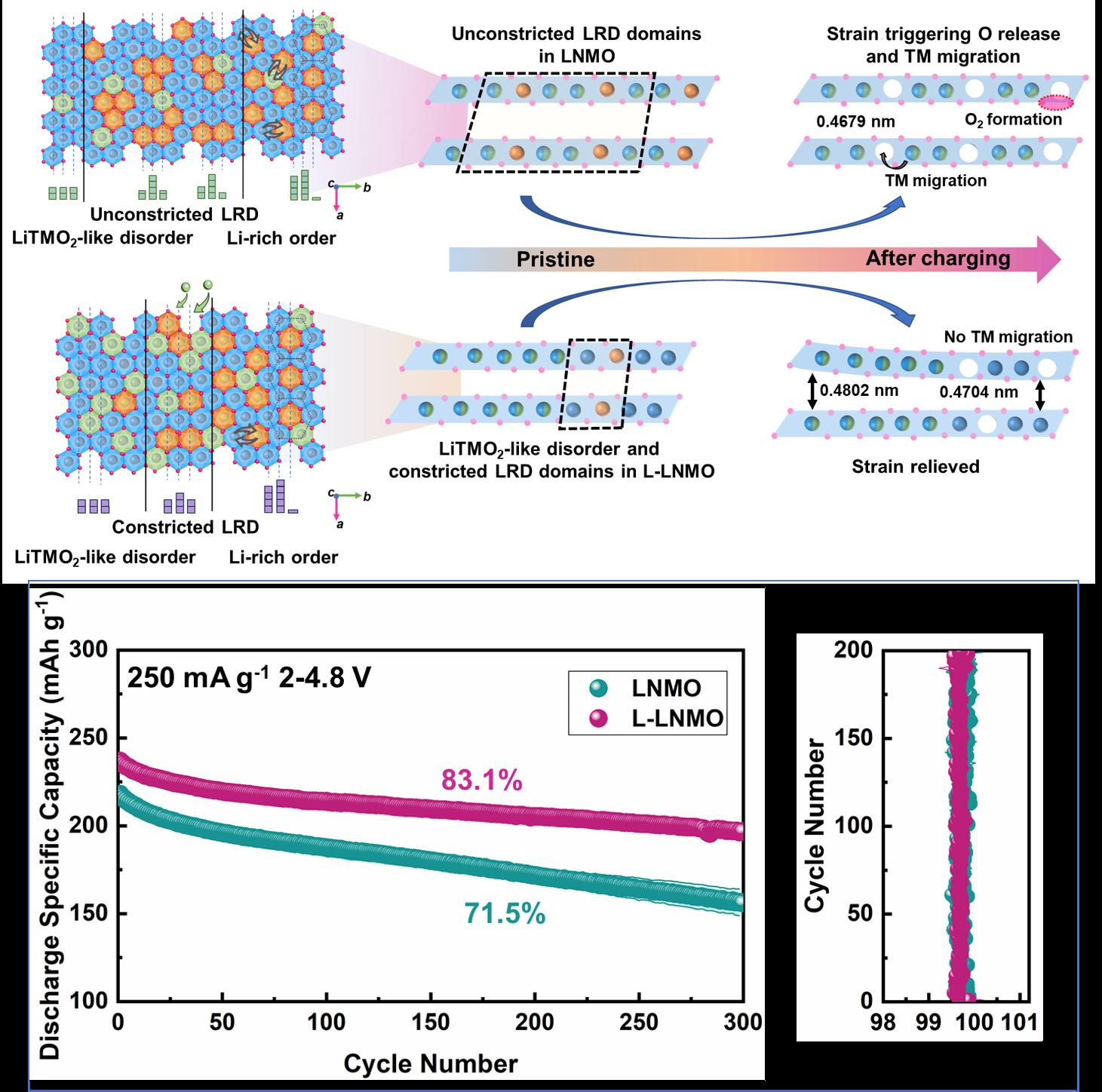
Constricted Li-Rich Disordered Domain Enhances Structural Stability
With the outstanding advantage of ultra-high specific capacity, lithium-rich cathode materials have become one of the most promising candidates for next-generation commercial high-performance lithium-ion battery cathodes. However, during charge and discharge, the inhomogeneity of redox reactions induces significant lattice strain and structural distortion, leading to rapid performance degradation. To tackle this key problem, Professor Wang Zhenbo's team has proposed for the first time that the Li-rich disordered domain (LRD domain) is the fundamental origin of severe structural instability during heterogeneous redox processes.
The study reveals that transition metals, particularly nickel, tend to occupy Li sites within this LRD domain. By tailoring the synthesis to constrict the LRD domain, the anisotropic lattice strain between adjacent regions can be effectively isolated, thereby suppressing oxygen loss and enhancing structural integrity. Electrochemical tests show significantly improved specific capacity: a 15% increase after 50 cycles at 0.1 C and a 26% increase after 300 cycles at 1 C, along with enhanced cycling stability. This work clarifies the key role of the LRD domain in stabilizing the structural evolution of high-capacity layered cathodes for the first time, opening up a new path for the precise regulation of heterogeneous electrochemical reactions in high-energy-density batteries.
Harbin Institute of Technology is the first corresponding affiliation of the paper. Xu Guijing, a Ph.D. candidate at the School of Chemistry and Chemical Engineering, is the first author. Professor Wang Zhenbo, Professor Zhao Lei, Associate Researcher Deng Liang from the School of Chemistry and Chemical Engineering, as well as Associate Professor Yu Fuda from Huaqiao University and Dr. Liao Zhongmiao from Dongguan University of Technology, are the co-corresponding authors. Ph.D. candidates Tang Jiaji and Ke Wang from the School of Chemistry and Chemical Engineering, Postdoctoral Fellow Jiang Yunshan from City University of Hong Kong, and Associate Researcher Zhang Nian from the Shanghai Advanced Research Institute, Chinese Academy of Sciences, are co-authors of the paper.
This research was supported by grants from the National Key Research and Development Program of China, the National Natural Science Foundation of China, and the China Postdoctoral Science Foundation.
Link to the paper: https://doi.org/10.1002/anie.6316407
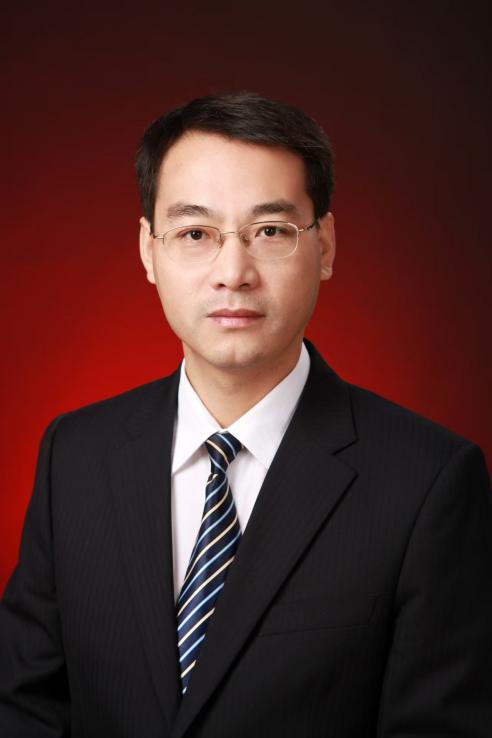 Professor Wang Zhenbo(王振波),Ph.D., is a professor and a doctoral supervisor at the School of Chemistry and Chemical Engineering, Harbin Institute of Technology. He is a recipient of the National High-Level Talent program, and a distinguished professor of the "Longjiang Scholar" program in Heilongjiang Province. He received the Hou Debang Chemical Science and Technology Innovation Award in 2022. He is named a Clarivate Highly Cited Researcher (2025) and has been recognized as an Elsevier Chinese Highly Cited Scholar for 12 consecutive years (2014–2025). His research focuses on advanced chemical power sources, hydrogen fuel cells, electrocatalysis, and nano-electrode materials. He has led multiple key projects, including those under the National Key Research and Development Program and the Key Program of the National Natural Science Foundation of China (NSFC). He has authored over 350 peer-reviewed SCI papers in journals such as Nature Catalysis, Nature Communications, Advanced Materials, and Angewandte Chemie International Edition. Among these, 26 are ESI highly cited papers (over a decade), and 8 are ESI hot papers. He holds 68 authorized invention patents. His honors includeone First Prize ofScience and Technology Progress (National Ministry Level) and two First Prizes of the Heilongjiang Provincial Natural Science Award.
Source: Harbin Institute of Technology