Recently, Assoc. Prof. Yang Xiaobin of Prof. Shao Lu’s group from School of Chemistry and Chemical Engineering and the State Key Laboratory of Urban-rural Water Resource and Environment developed a biomimetic catalytic self-cleaning water treatment membrane. The relevant research, titled “Lotus-leaf-mimetic catalytic cleaning membranes with enriched oxygen vacancies for efficient water purification,” was published in Nature Communications. This study provides an innovative technical route for the development and widespread application of efficient, low-carbon water treatment membrane materials.
Pressure-driven separation membranes are a key technologies supporting the sustainable development of the energy-water nexus. However, membrane fouling has long limited their practical application. Conventional hydrophobic polymer membranes are easily clogged by organic contaminants during water treatment, leading to flux decline, frequent cleaning, and high operating costs. Ex situ cleaning methods also suffer from high resource consumption and significant environmental impacts.
Inspired by the hierarchical microstructure and self-cleaning properties of natural lotus leaves, the team innovatively developed a mild two-step interfacial construction strategy. First, an HHTP-Co metal-organic interlayer was built on a hydrophobic polymer membrane substrate, and then used it to mediate the controllable mineralization of manganese dioxide, transforming the ordinary hydrophobic membrane into a novel membrane material with triple functions: superhydrophilicity, underwater superoleophobicity, and catalytic self-cleaning. The biomimetic membrane features a raspberry-like micro/nanostructure on its surface, and a dynamic water-cushion barrier resembling the nano/micro air chambers of lotus leaves formed at the interface. Meanwhile, a large number of oxygen vacancies were generated during the heterogeneous mineralization process, greatly enhancing the membrane’s catalytic ability to remove fouling and giving it excellent anti-fouling and in situ regeneration performance in oily wastewater treatment. Theoretical calculations revealed the strong coordination between the interlayer and metal ions, providing a theoretical basis for the design and fabrication of similar biomimetic catalytic membranes. This study also proposed an evaluation model for membrane anti-fouling merit, and the antifouling figure of merit of the modified membrane was 24.8 times that of the control membrane. The modified membrane maintained good separation performance and structural integrity under complex conditions such as acid, alkali, and salt exposure, making it promising for industrial oily wastewater purification, municipal sewage treatment, and drinking water safety assurance.
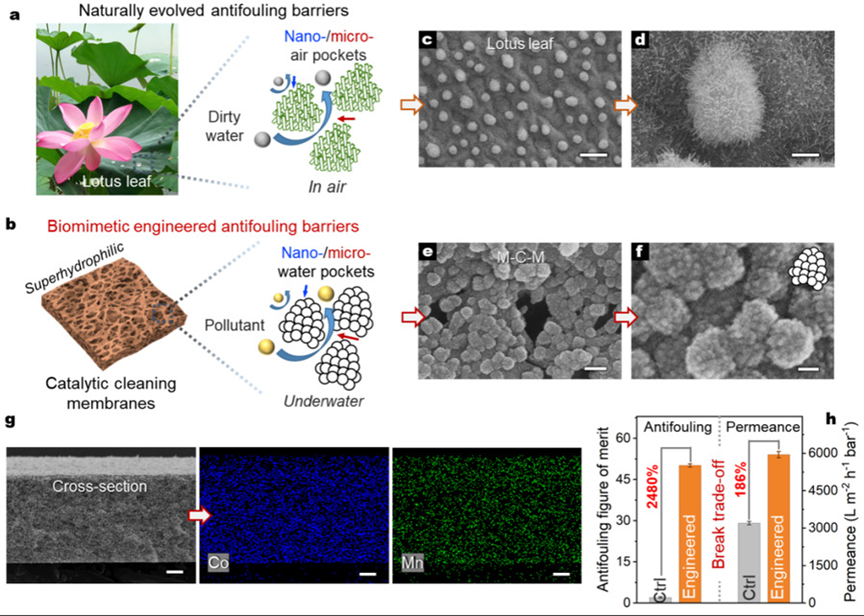
Biomimetic interface engineering of antifouling barriers on membranes. (a, b) A scheme of lotus-inspired interface antifouling engineering on polymeric membranes with a catalytic cleaning function via the formation of nano/micro-water pockets via mimicking nano-/micro air pockets among microscopically structured mountains and valleys of a lotus leaf. SEM images of the surfaces of (c, d) a lotus leaf and (e, f) the membrane with the Co-HHTP-mediated MnO2 mineralization (M-C-M). (g) EDS mapping images (Co, Mn) of the cross-section of M-C-M. (h) The resulting membrane breaks the trade-off between the antifouling figure of merit and permeance (for the emulsion separations).
Harbin Institute of Technology is the first corresponding affiliation of this paper. Assoc. Prof. Yang Xiaobin from the School of Chemistry and Chemical Engineering is the first author. Professor Shao Lu, Academician Bhekie B. Mamba of the University of South Africa, and Professor Alicia Kyoungjin An of the Hong Kong University of Science and Technology are the co-corresponding authors. Academician Ma Jun from the School of Environment, along with PhD students Bao Hongfei, Wang Haoyang, and Li Yangxue, as well as master’s students Gao Runliang and Wang Xinyu from the School of Chemistry and Chemical Engineering, participated in the research. The study was supported by the National Natural Science Foundation of China, the Fundamental Research Funds for the Central Universities, and the Independent Research Project of the State Key Laboratory of Urban Water Resource and Environment.
Article link:https://doi.org/10.1038/s41467-026-72088-2
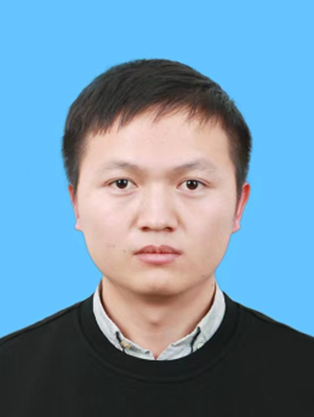
Yang Xiaobin is an Associate Professor and Doctoral Supervisor in the Department of Polymer Science and Engineering at the School of Chemistry and Chemical Engineering, Harbin Institute of Technology (HIT). He is also a core member of the State Key Laboratory of Advanced Inorganic Fibers and Composites. In 2021, he was selected for the National Postdoctoral Program for Innovative Talents (first cohort). His research focuses on the preparation of water treatment membrane materials, interfacial functional engineering, and activated atomic layer deposition. He has published 56 SCI-indexed papers, achieving an H-index of 41 and over 5,160 citations on Google Scholar. Among these, 30 papers were published as the first or corresponding author in highly regarded journals such as Nature Communications, Proceedings of the National Academy of Sciences (PNAS), Advanced Materials (Cover story), Matter (a sister journal to Cell), Science Bulletin, and Journal of Membrane Science. Additionally, he has co-authored one chapter in an English book published by Wiley-VCH and holds four authorized invention patents. Dr. Yang currently leads five research projects, including the Young Scientists Fund of the National Natural Science Foundation of China (NSFC). His work has been recognized with the Second Prize of the Heilongjiang Provincial Natural Science Award (2021) and the First Prize of the Science and Technology Award for Higher Education Institutions of Heilongjiang Province (2021, Technological Invention). Furthermore, he has served as a Session Chair at the 13th Conference of the Aseanian Membrane Society (AMS13) and as a Youth Editorial Board Member for the journal Nano-Micro Letters.
Source: Harbin Institute of Technology