Recently, Prof. Wang Zhenbo’s team from the School of Chemical Engineering and Chemistry has made an important advance in the field of electrocatalysts for proton exchange membrane fuel cells. The team innovatively proposed a hydrogen-embrittlement-like assisted thermal activation strategy and successfully constructed atomically dispersed catalysts. The related research, titled “Synthesis of atomically dispersed catalysts via hydrogen embrittlement-like assisted thermal activation for acidic oxygen reduction,” was published in Nature Communications. This study is expected to open up a new avenue for the design and application of next-generation cathode catalysts for proton exchange membrane fuel cells.
A major scientific challenge lies in the difficulty of forming monodispersed states for 4d/5d transition metals due to their high cohesive energy. To address this issue, this team developed a hydrogen-embrittlement-like assisted thermal activation strategy. During high-temperature synthesis, hydrogen penetrates the metal clusters, weakening the metal–metal interactions within them and causing the clusters to collapse into individual metal atoms, which are subsequently anchored by doped nitrogen into the carbon support, ultimately forming stable M–N4 single-atom active sites. Taking ruthenium (Ru) as the model system, the team combined ex situ electron microscopy and spectroscopic characterization to provide solid evidence for the proposed mechanism. During hydrogen-assisted thermal treatment, hydrogen penetration breaks Ru–Ru bonding and converts Ru clusters into isolated RuN4 sites. The NC-Ru-950 catalyst prepared by this method exhibits excellent catalytic activity and stability in both the acidic oxygen reduction reaction and proton exchange membrane fuel cells. This work offers an efficient and universal strategy to stabilize 4d/5d transition metals into single-atom catalysts, offering a promising route toward the construction of high-performance electrocatalysts.
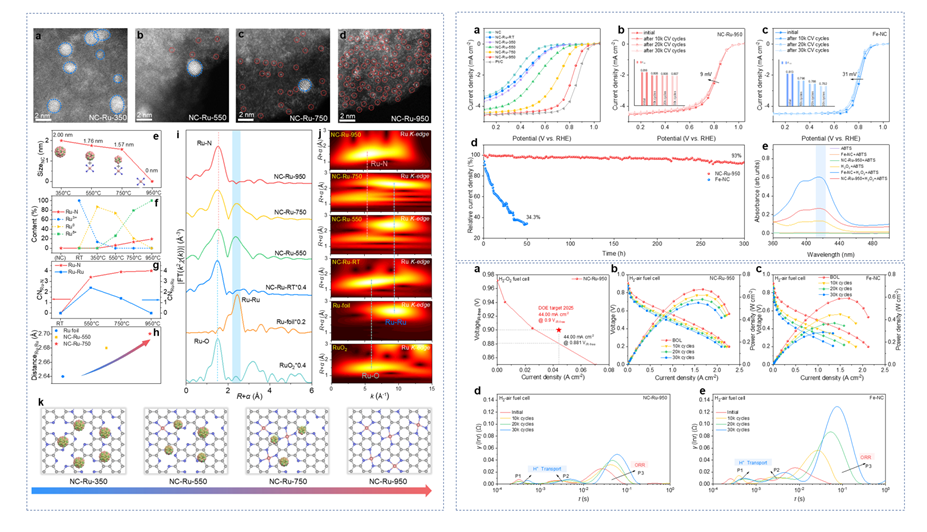
Construction of atomically dispersed Ru-based catalysts via a hydrogen-embrittlement-like assisted thermal activation strategy
Harbin Institute of Technology is the first corresponding affiliation for this paper. Guo Pan, a PhD student from the School of Chemistry and Chemical Engineering, is the first author. Professors Wang Zhenbo, Zhao Lei, and Associate Prof. Zhang Yunlong from the School of Chemistry and Chemical Engineering, together with postdoctoral researcher Shen Lixiao from Shenzhen University, are the co-corresponding authors. Co-authors include PhD students Dai Yunkun, Liu Bing, Ma Miao, Liu Bo, and Zhang Ziyu from the School of Chemistry and Chemical Engineering, PhD student Zhao Zegang from Harbin Engineering University, and Prof. Chen Aibing from Hebei University of Science and Technology. This study was supported by the National Natural Science Foundation of China, the Key Research and Development Program of Shandong Province, and the Natural Science Foundation of Heilongjiang Province, etc.
Article link: https://www.nature.com/articles/s41467-026-71340-z
Source: Harbin Institute of Technology