Recently, Prof. Xiaojun Han’s research team at the State Key Laboratory of Urban-rural Water Resource and Environment, School of Chemistry and Chemical Engineering, Harbin Institute of Technology, has achieved significant progress in the field of artificial cell research, addressing a long-standing challenge in regulating intracellular metabolism through G protein–coupled receptor (GPCR)–mediated signal transduction in artificial cells. The related work, entitled “An artificial cell capable of signal transduction mediated by ADRB2 for the regulation of glycogenolysis”, was published in Nature Communications. This study lays an important foundation for the construction of autonomous artificial cells with capable of communicating with their environment for metabolism.
Cellular signal transduction is a fundamental mechanism by which cells communicate with their environment. In current artificial cell research, signal transduction largely relies on synthetic receptors, which are often unable to generate intracellular second messengers and thereby regulate metabolic pathways. G protein–coupled receptors (GPCRs) represent the largest family of membrane receptors and play critical roles in hormone- and neurotransmitter-mediated signaling. However, reconstructing GPCR signaling pathways in artificial cells to control downstream metabolism has remained a major challenge.
To overcome this limitation, the team reconstituted β2-adrenergic receptor (ADRB2), Gs protein α subunit (Gsα), and adenylyl cyclase V (ADCY5) within artificial cells, successfully establishing a complete signal transduction pathway. Upon binding of the extracellular first messenger isoproterenol (ISO) to ADRB2, Gsα is activated and subsequently stimulates ADCY5 to generate the second messenger cyclic adenosine monophosphate (cAMP). cAMP then activates protein kinase A (PKA), triggering a phosphorylation cascade of phosphorylase kinase (PhK) and glycogen phosphorylase (PYGM) required for glycogenolysis. As a result, glycogen is converted into glucose-1-phosphate (G-1-P), which is further transformed enzymatically into 6-phosphogluconolactone and NADPH. Throughout the signal transduction process, the artificial cells exhibit a hierarchical signal amplification cascade, from ISO to cAMP, G-1-P, and 6-phosphogluconolactone. This work represents the first demonstration of complete GPCR-mediated signal transduction and metabolic regulation in artificial cells, providing a solid foundation for the development of artificial cells with autonomous sensing, response, and regulatory capabilities.
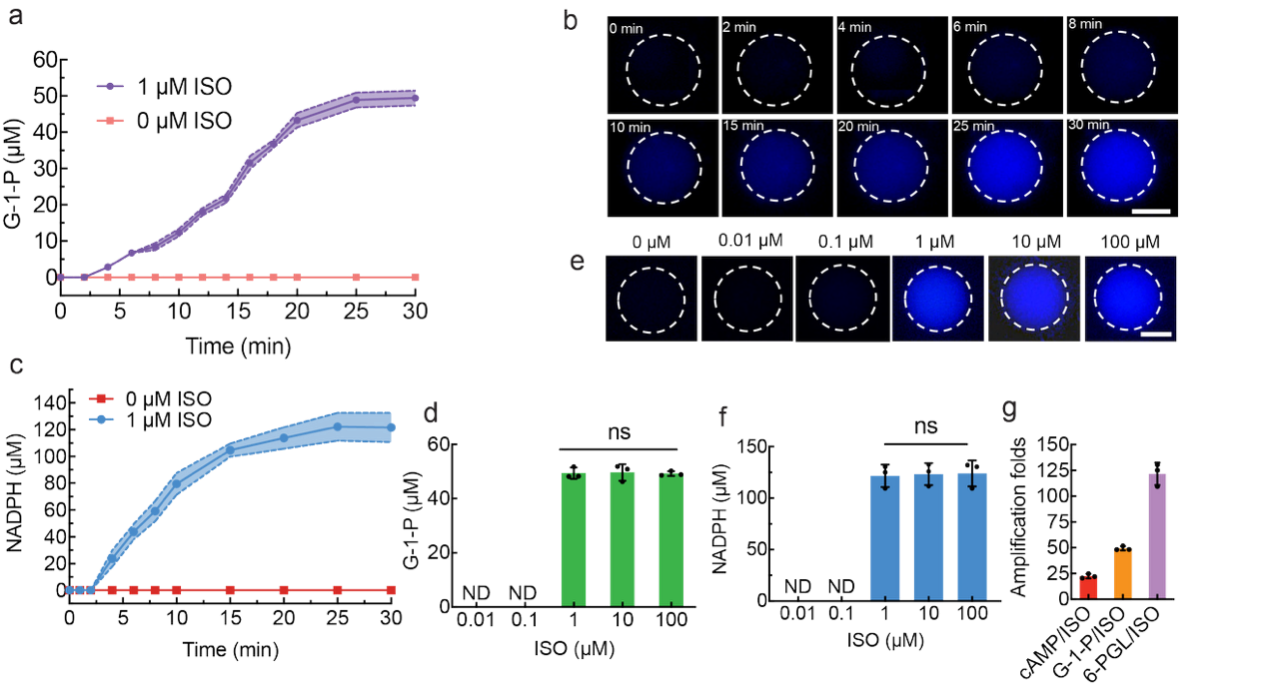
Artificial cells containing ADRB2 enable signal-transduction-regulated intracellular glycogenolysis.
Harbin Institute of Technology is the sole corresponding affiliation of the paper. Prof. Xiaojun Han from the School of Chemistry and Chemical Engineering and Associate Researcher Shubin Li are the co-corresponding authors. Yanhao Liu, a PhD candidate, is the first author, while Associate Researchers Xiangxiang Zhang and Jingjing Zhao, PhD candidates Wan Zhao, Yingming Zhao, and Yongshuo Ren participated in the research.
This work was supported by the National Natural Science Foundation of China and the Key Program of the Natural Science Foundation of Heilongjiang Province.
Paper link: https://www.nature.com/articles/s41467-026-68503-3

Xiaojun Han, Professor and PhD supervisor, serves as Chair of the Department of Chemistry. He is a Nationally Recognized High-level Talent and a Fellow of the Royal Society of Chemistry (FRSC). He is also a member of the Teaching Steering Committee for Chemical Engineering and Technology under the Ministry of Education, a senior member of Chinese Chemical Society, a recipient of the New Century Excellent Talents Program, and a winner of the Heilongjiang Province Outstanding Youth Science Fund.
His main research areas include artificial cells, cancer diagnosis and therapy, drug delivery, pollutant detection and remediation, and biosensors.
Source: Harbin Institute of Technology