The team led by Professor Lu Shao, a member of the State Key Laboratory of Urban-rural Water Resource and Environment and a professor at the School of Chemistry and Chemical Engineering, has synthesized polymer woven Metal-Organic Framework (MOF) glass membranes. Relevant research, titled "Synthesizing Polymer Woven Metal-Organic Framework Glass Membranes for Exceptional Pressure-Tolerant Carbon Capture," was published in the Journal of the American Chemical Society (JACS). This work expands the toolbox for the synthesis of functional MOF glasses and provides a new approach for the development of next-generation gas separation membranes.
Liquid-processable MOF glasses well redefine the ideal materials for energy-efficient carbon capture membranes. However, MOF glass membranes still suffer from poor pore connectivity, inadequate porosity and severe pressure vulnerability, hindering the sustainable deployment of membrane technologies in flue gas decarbonization, natural gas valorization, etc.
To address these problems, inspired by the structure of spider silk in nature, the team has synthesized a novel family of polymer woven MOF (pw-MOF) glasses. During the melting process, the woven polymer prevents lattice deformation while undergoing nanophase interface segregation (Nano-IS) evolution, which effectively regulates kinetic mass transfer efficiency and thermodynamic polar adsorption effects. The newly synthesized pw-MOF glass membranes contain connected sub-nanometer penetrating channel networks, and the high-density polar domains along the polymer chains possess excellent adsorption capacity, thereby greatly enhancing carbon capture and separation performance. Owing to the unique woven-reinforced framework, the pw-MOF glass membranes exhibit unprecedented pressure tolerance of up to 7.5 atm whereas existing MOF glass membranes can only withstand approximately 1 atm. The potential applications of this work achievement cover fields such as inert gas purification, waste gas treatment, and key low-carbon separation, which can closely link interdisciplinary fields including membrane science, chemical engineering, materials chemistry, physical chemistry, nanoscience, and environmental engineering.
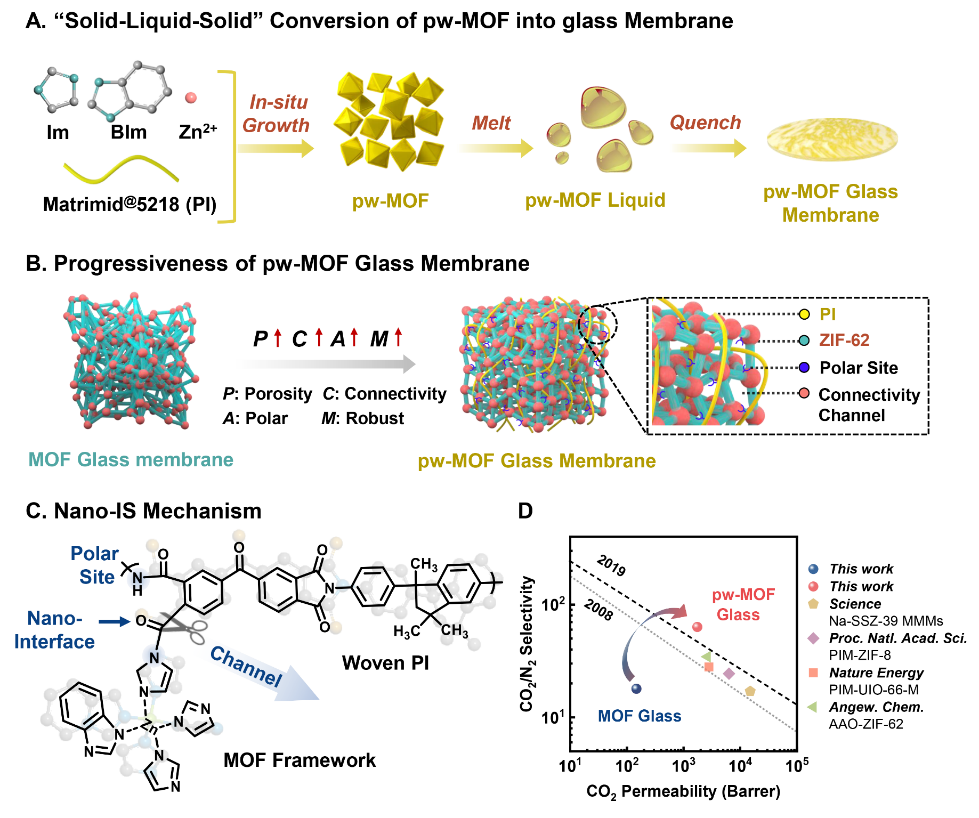
Synthesis of the pw-MOF glass membrane. (A) Schematic illustrations of “Solid-Liquid-Solid” conversion of pw-MOF crystals into a glass membrane. (B) Progressiveness of the pw-MOF glass membrane. (C) Schematic illustrations of Nano-IS evolution of the membranes. (D) Comparison with state-of-the-art materials.
Harbin Institute of Technology is the first corresponding affiliation of the paper. Yang Yan (杨延), a Ph.D. candidate from the School of Chemistry and Chemical Engineering, is the first author of the paper. Prof. Shao Lu and Associate Researcher Jiang Xu (姜旭) from the School, and Dr. Cher Hon Lau (刘哲鸿) from the School of Engineering, the University of Edinburgh, are the co-corresponding authors. Graduate students Liu Weihao (刘威豪) and Guo Lei (郭磊), and undergraduate student Hao Jingyan (郝婧妍), also participated in the relevant research work.
This work was supported by the National Key R&D Program, National Natural Science Foundation of China, the Fundamental Research Funds for the Central Universities of Ministry of Education, and other projects.
Link to the paper: https://pubs.acs.org/doi/10.1021/jacs.5c17503
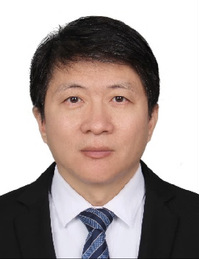
Shao Lu, Professor and Ph.D. Supervisor, is a National High-Level Talent, a Fellow of the Royal Society of Chemistry (FRSC), and the Principal Investigator of a National Key Research and Development Program project. Rooted in Northeast China, he has independently led his team in conducting in-depth and systematic research in the field of low-carbon separation functional membrane materials and membrane processes featuring hierarchically evolved pore structures. His research interest particularly focuses on membrane applications in energy and environmental protection, including the development of a series of high-efficiency ion-separation membranes, as well as specialized membranes with anti-fouling, temperature-resistant, acid/alkali-resistant properties.
Source: Harbin Institute of Technology