The research team led by Professor Lu Shao (邵路),affiliated with the School of Chemistry and Chemical Engineering and the State Key Laboratory of Urban Water Resource and Environment, proposed the concept of sustainable and high-efficiency water-purifying nanofiltration membranes. The related research, titled "Sustainable Nanofiltration Membranes Enable Ultrafast Water Purification," has been published in Nature Water. This achievement not only fills a crucial gap in sustainable nanofiltration technology by simultaneously achieving degradability and high performance, but also establishes a new paradigm for the green design and industrial application of membrane materials.
In the context of the increasingly severe environmental pollution and the growing scarcity of water resources,, the development of green, safe, and sustainable water treatment technologies has become a global research focus. As an important component of high-efficiency separation technologies, nanofiltration (NF) membranes have been widely used in industrial wastewater treatment and resource recovery in recent years. However, traditional NF membranes usually rely on petrochemical-based raw materials, involve hazardous solvents in their manufacturing process, and the membrane materials are non-biodegradable. These factors severely limit their environmental adaptability and potential for sustainable development.
To address the aforementioned bottlenecks, the team, guided by the principles of green chemistry, established a novel green and sustainable NF membrane system, guided by the principles of green chemistry. The sustainable nanofiltration membrane (SNFM) uses polylactic acid (PLA) as the substrate, adopts low-hazard chemicals such as xylitol, dopamine (DA) and oleic acid (OA), and constructs a unique wavy nano-selective layer via interfacial polymerization.This approach has two significant advantages. Firstly, it avoids the use of conventional high - risk solvents. Secondly, it endows the membrane with the ability to be biodegraded by microorganisms in natural soil environments, thus achieving full - life - cycle membrane - based water purification.
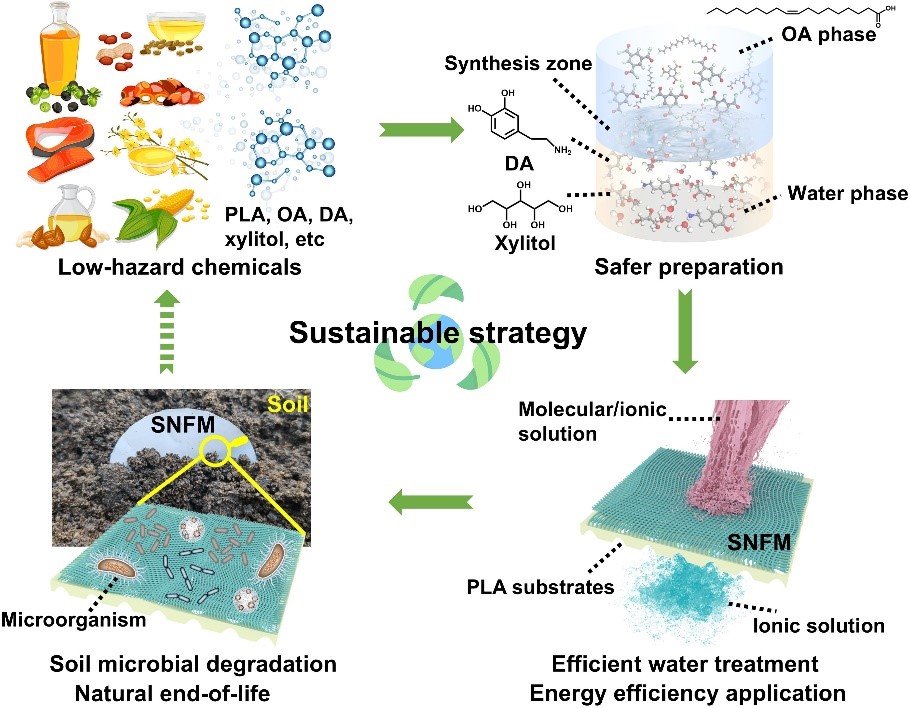
Schematic diagram of the sustainability of the SNFM
Studies have shown that SNFM exhibits ultrahigh water permeance (up to 100.7 L m-2 h-1 bar-1) in dye wastewater treatment, with a rejection rate of 99.9% for organic active molecules such as Congo Red. Its separation performance is significantly superior to that of current commercial membranes and state-of-the-art research membranes. More importantly, the membrane can be completely degraded by typical microorganisms in enzymatic environments and natural soil, with a degradation rate exceeding 90% within 6 months. The degradation products are non-toxic to the environment and microorganisms, truly realizing the full-life-cycle sustainable membrane technology that is ‘green at the source, efficient in use, and degradable at the end-of-life’.
Harbin Institute of Technology is the first corresponding affiliation of the paper. Prof. Shao Lu from the School and Prof. Wang Huanting (王焕庭) from Monash University, Australia are the co-corresponding authors. Huang Junhui (黄军辉), a Ph.D. candidate at the School, is the first author of the paper. Other researchers who contributed to the work include Prof. Zhang Yanqiu (张艳秋) and Associate Researcher Guo Jing (郭靖) from the School; Prof. Qiu Shan (邱珊) from the School of Environment and Ph.D. candidate Yuan Mu (袁木).
This work was supported by the National Key R&D Program, National Natural Science Foundation of China, the Fundamental Research Funds for the Central Universities of Ministry of Education, and other projects.
Link to the paper: https://www.nature.com/articles/s44221-025-00492-x
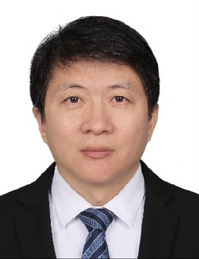
Shao Lu, Professor and Ph.D. Supervisor, is a National High-Level Talent, a Fellow of the Royal Society of Chemistry (FRSC), and the Principal Investigator of a National Key Research and Development Program project. Rooted in Northeast China, he has independently led his team in conducting in-depth and systematic research in the field of low-carbon separation functional membrane materials and membrane processes featuring hierarchically evolved pore structures. His research interest particularly focuses on membrane applications in energy and environmental protection, including the development of a series of high-efficiency ion-separation membranes, as well as specialized membranes with anti-fouling, temperature-resistant, acid/alkali-resistant properties.
Source: Harbin Institute of Technology