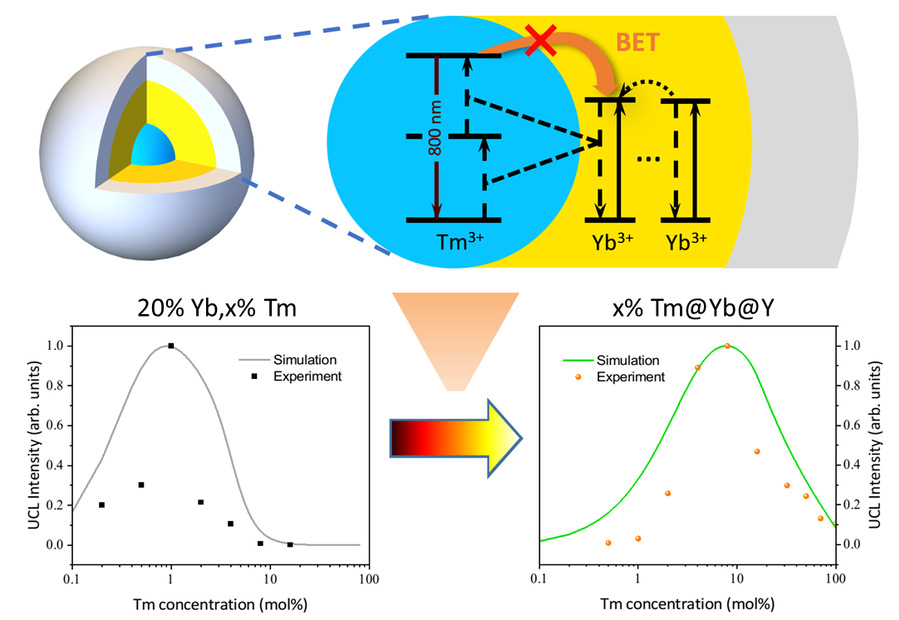
Recently, the research team led by Prof. Guanying Chen at the School of Chemistry and Chemical Engineering, Harbin Institute of Technology, has made significant progress in the study of concentration quenching in rare-earth upconversion luminescence. The research, entitled “Inhibiting concentration quenching in Yb³⁺–Tm³⁺ upconversion nanoparticles by suppressing back energy transfer”, was published in Nature Communications and selected as an Editors’ Highlight by the journal. In this work, the team effectively optimized the energy-transfer process between rare-earth activator and sensitizer ions by spatially separating them, thereby successfully suppressing concentration quenching in upconversion luminescence. The study reveals that back energy transfer from activator ions to sensitizer ions, as well as cross-relaxation among activator ions, are two independent and critical factors responsible for concentration quenching. This achievement is expected to promote the frontier applications of rare-earth upconversion nanocrystals in bioimaging, biosensing, and solid-state laser technologies.
Highly efficient rare-earth upconversion nanocrystals typically adopt a sensitizer–activator co-doping strategy, in which sensitizer ions absorb the excitation energy and efficiently transfer it to activator ions, thereby populating their high-energy excited states and enabling anti-Stokes upconversion luminescence. Although the efficiency of this multistep upconversion process is generally higher than that of conventional multiphoton fluorescence, the emission brightness of rare-earth nanocrystals remains severely limited by the concentration quenching of activator ions, resulting in relatively weak upconversion luminescence that fails to meet the requirements of many practical applications.
The team developed a hexagonal-phase NaYF₄-based heterostructured core–shell–shell nanostructure (NaYF₄:Tm³⁺@NaYbF₄@NaYF₄), in which the activator ions (Tm³⁺) and sensitizer ions (Yb³⁺) are spatially confined within the inner core and the intermediate shell, respectively, while the outermost inert shell is employed to suppress surface quenching effects. This rational design enables effective suppression of concentration quenching at excitation power densities below 100 W cm-2, increasing the optimal Tm³⁺ doping concentration from 1% in conventional single-core co-doped NaYF₄:Yb³⁺/Tm³⁺ nanocrystals to 8%. Mechanistic investigations reveal that spatial separation of sensitizer and activator ions effectively suppresses back energy transfer from Tm³⁺ to Yb³⁺, thereby enabling a higher optimal Tm³⁺ doping concentration. Moreover, under high excitation power density (20 MW cm-2), the optimal Tm³⁺ doping level can be further increased to 50%. These findings deepen the understanding of concentration quenching in lanthanide luminescence and provide new opportunities for the development of high-brightness rare-earth upconversion materials.
Prof. Guanying Chen is the sole corresponding author of the paper, with Harbin Institute of Technology as the first corresponding affiliation. Dingxin Huang, a PhD candidate at the School of Chemistry and Chemical Engineering, Harbin Institute of Technology, is the first author, and Feng Li, also a PhD candidate, is the second author. Prof. Hans Ågren, Chair Professor at Harbin Institute of Technology, also contributed to this work.
This work was supported by the National Natural Science Foundation of China, the Young Scientist Studio of Harbin Institute of Technology, and other related funding programs.
Publication Link: https://www.nature.com/articles/s41467-025-59452-4
Editors’ Highlights Link: https://www.nature.com/collections/wtpqpqpgwd

Guanying Chen is a Professor and PhD Supervisor at the School of Chemistry and Chemical Engineering, Harbin Institute of Technology, and serves as Head of the Department of New Energy Materials and Devices. He is a recipient of both national high-level talent and national young talent programs. His research interests focus on rare-earth luminescent materials, biophotonics, and solar cells.
Homepage: http://homepage.hit.edu.cn/guanyingchen