Recently, a research team led by Professor Yu Yongsheng (于永生), a faculty member of the School and the State Key Laboratory of Urban Water Resources and Water Environment, and Associate Professor Yang Weiwei (杨微微), in collaboration with Professor Guo Shaojun (郭少军)'s team from Peking University, has achieved a breakthrough in the field of electrocatalytic hydrogen evolution. They proposed a salt-templating method to introduce oxygenophilic Mg and Mo sites onto amorphous Ru metallene, which significantly enhances the alkaline hydrogen evolution reaction (HER) electrocatalytic performance through the synergistic promotion of water adsorption and splitting. The research findings, titled "Synergetic Oxidized Mg and Mo Sites on Amorphous Ru Metallene Boost Hydrogen Evolution Electrocatalysis," have been published in Advanced Materials. This work holds significant value as it not only deepens our understanding of the water - splitting reaction mechanism but also offers new perspectives for the development of efficient electrocatalysts. Consequently, it shows great promise in promoting the advancement of renewable energy development.Hydrogen is favored due to its high energy density, high combustion efficiency, and clean, pollution-free nature. Nevertheless, the slow water splitting reaction poses a severe limitation to the development of alkaline water electrolysis for hydrogen production. Ruthenium (Ru), as a relatively low-cost catalyst, shows platinum-like high activity in the alkaline hydrogen evolution reaction (HER). However, its insufficient hydrophilicity restricts the water splitting efficiency. The introduction of oxygenophilic species can enhance the activation and splitting of water molecules.Regrettably, current research in this area is still inadequate.
Based on this foundation, the research team adopted a straightforward salt - templating approach. They achieved gram - scale synthesis of ultrathin amorphous Ru metallene through low - temperature calcination of metal acetylacetonate in the air. The introduction of Mg and Mo sites enhances the mass activity of the amorphous Ru metallene for HER by 15.3 times at an overpotential of 100 mV, and this electrocatalyst exhibits an ultralow overpotential of 8.5 mV at a current density of 10 mA cm-2. The research results show that Mg sites enrich interfacial water molecules through p-p interaction, while Mo sites lower the water splitting energy barrier by filling hydrogen-oxygen antibonding orbitals. The Mg and Mo sites synergistically promote the adsorption and splitting of water molecules, thereby significantly improving the alkaline HER activity of Ru metallene. Overall, by constructing an ultrathin two-dimensional structure and introducing synergistic sites, this strategy significantly improves the utilization rate and activity of the noble metal Ru. As a result, it shows great potential for achieving the replacement of expensive Pt - based catalysts with Ru - based catalysts.Harbin Institute of Technology is the first corresponding affiliation of the paper. Yu Yongsheng, Yang Weiwei, and Guo Shaojun are the co-corresponding authors. Tian Fenyang (田奋扬), a Ph.D. candidate at the HIT School of Chemistry and Chemical Engineering, and Geng Shuo (耿硕), an associate professor at Guizhou University, are the co-first authors. Other researchers who contributed to the work include: Prof. Li Menggang (李蒙刚) and Prof. Zhou Xin (周欣) from School of Chemistry and Chemical Engineering; Ph.D. candidates Qiu Longyu (邱龙宇), Wu Fengyu (吴丰羽), and He Lin (何林) from the same school; Associate Researcher Sheng Jie (盛捷) and Engineer Chen Zhaoyu (陈肇宇) from the Institute of Space Environment and Material Science of HIT; Researcher Luo Mingchuan (骆明川) from Peking University; and Prof. Liu Hu (刘虎) from the Qinghai Lake Institute of the Chinese Academy of Sciences.
The research was supported by the National Natural Science Foundation of China (NSFC) and other projects.
Link to the paper: https://doi.org/10.1002/adma.202501230
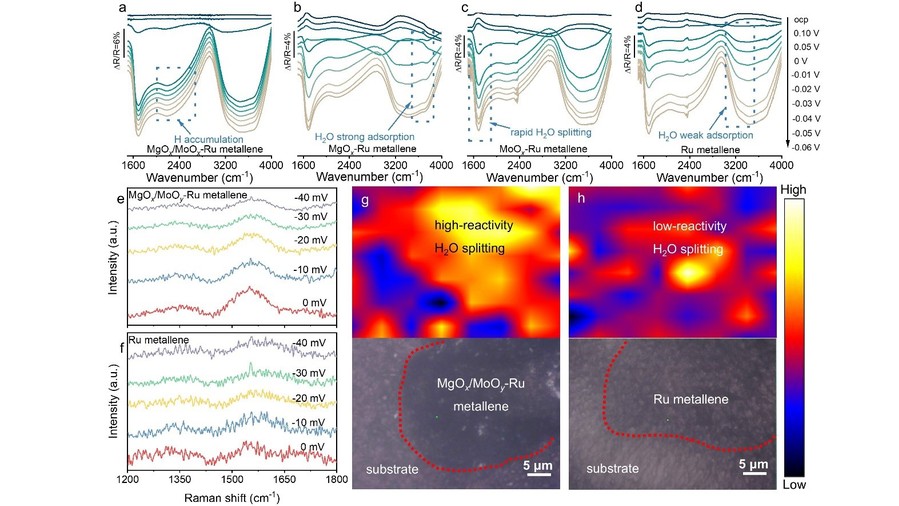
Operando spectroscopic characterizations during HER electrocatalysis.
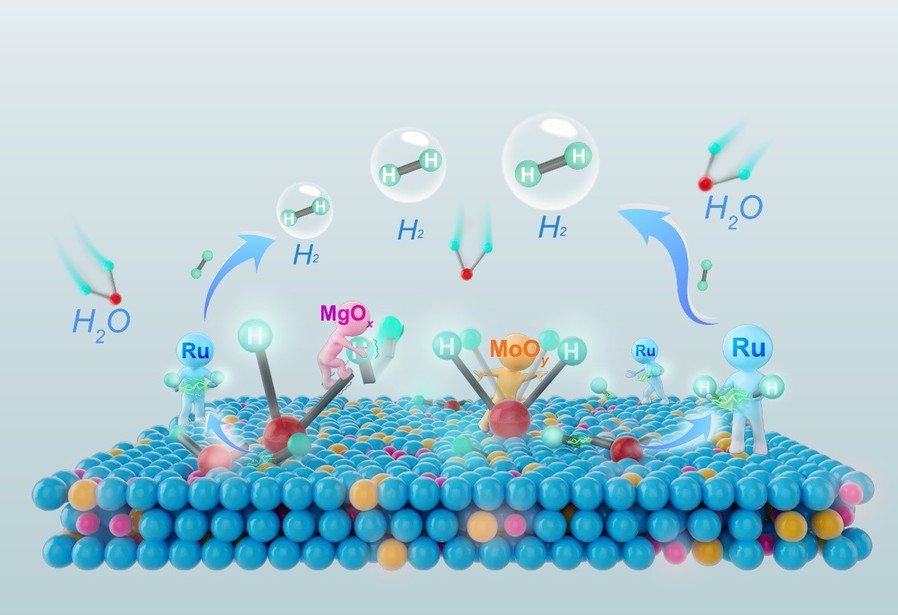
Catalytic reaction mechanism of HER on the surface of amorphous Ru metallene
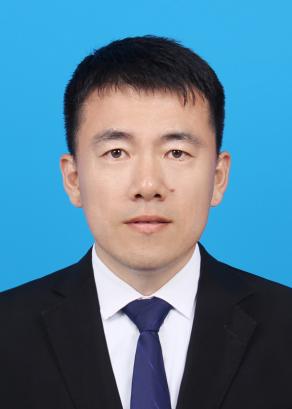
Yu Yongsheng, Professor and Ph.D. Supervisor at the Department of New Energy Materials and Devices, School of Chemistry and Chemical Engineering, Harbin Institute of Technology. Main Research Areas: Nanostructured permanent magnetic materials, electrocatalysis and supercapacitors, nanomaterials for water treatment.

Yang Weiwei, Associate Professor and Ph.D. Supervisor at the Department of Chemistry, School of Chemistry and Chemical Engineering, Harbin Institute of Technology. Main Research Areas: Electrochemical DNA and aptamer-based biosensors, applications of multi-metallic nanomaterials in biosensors.
(Source: Harbin Institute of Technology)