Recently, the collaborativecollaborated research team led by Professor Miao Yu from the School of Chemistry and Chemical Engineering, and Professor Ye Sun from the School of Instrumentation Science and Engineering, has achieved a significantmade an important breakthrough in the field of photoinduced reconstruction. They have, for the first time, realized surface reconstruction triggered by photoinduced interlayer atomic migration, thoroughly revealedelucidated the underlying transition mechanism in depth, and successfully accomplishedachieved a photoinduced semiconductor-to-metal transition (PSMT). The research findings, entitled “Semiconductor-to-metal surface reconstruction in copper selenide/ copper heterostructures steered by photoinduced interlayer atom migration”, have been published in Nature Communications. This work provides a new avenue for the design of novel optoelectronic detectors, high-efficiency catalysts, and functional materials, and is expected to advance innovation and applications of optically driven material modulation technologies across multiple fields.
Surface reconstruction as As a key approach to regulating the chemical and physical properties of materials, surface reconstruction has broad applications in catalysis, sensing, surface engineering, and device design. Compared with conventional methods, photoinduced surface reconstruction has attracted particular attention owing to its unique advantages of such as non-contact operation, high controllability, and reversibility. In this work, a monolayer Cu2Se system epitaxially grown on a Cu(111) surface was used to successfully realize a UV-light-induced PSMT. Using scanning tunneling microscopy (STM), the team confirmed that ultraviolet irradiation induces pronounced significant reconstruction of the Cu2Se monolayer on Cu(111). Subsurface Cu atoms in the subsurface migrate to the outermost layer, while all seleniumSe atoms move transfer to the subsurface. As a result, an ordered single-atomic Cu copper layer is formed at on the surface and a new Cu2Se monolayer is generated in the subsurface region. Further analysis by via scanning tunneling spectroscopy (STS) verified that the surface electronic structure has successfully transformed from a semiconducting to a metallic state. Density functional theory (DFT) calculations revealed that photoinduced electronic excitation plays a key crucial role in lowering the transition energy barrier, making the transition more facile in the excited state. Moreover, thermal activation enables the surface to fully revert from the monolayer metallic Cu state to the initial Cu2Se monolayer. This bidirectional transition from Cu2Se to Cu and back to Cu2Se monolayer can be cycled repeatedly, exhibiting high reversibility.
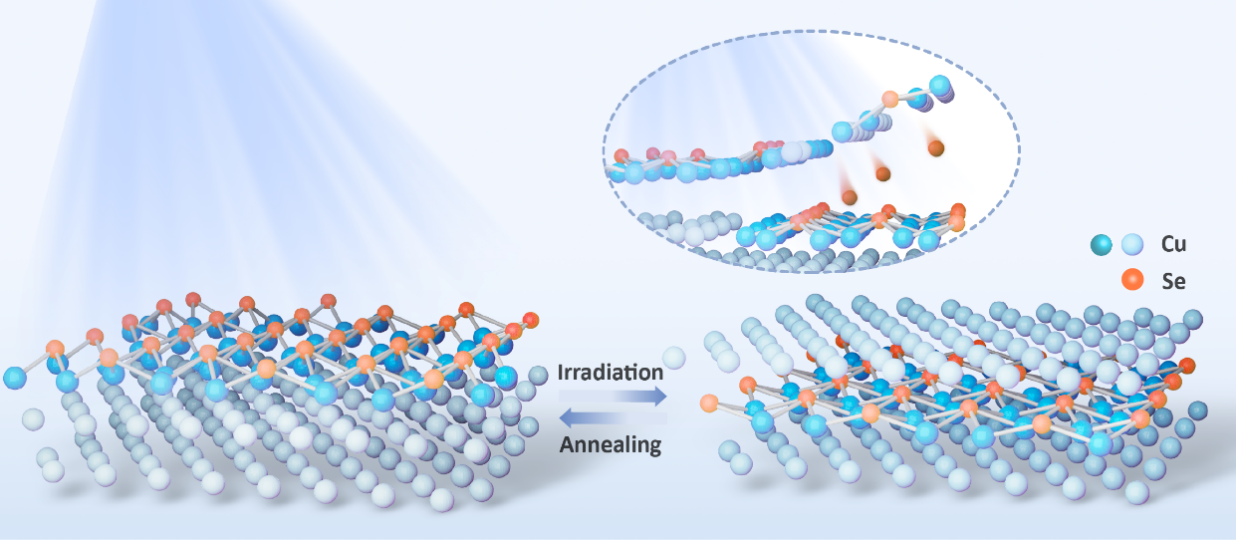
Schematic illustration of the photoinduced Cu2Se to Cu transition on the Cu(111) surface and its thermally induced reversible reconstruction
This study is the first to demonstrate confirm that a phase transition driven by photoinduced interlayer atomic migration can occur between completely two entirely different distinct materials. , This finding breaks throughing the conventional limitation that of PSMT is confined to phase transitions within a single material. It and elucidates the photoinduced surface PSMT transition and its mechanism physically in real space at the atomic scale, expanding. It broadens the research scope of photoinduced surface reconstruction and further highlights demonstrating the great potentialbroad prospects of dynamically tuning surface electronic structures.
Professor Miao Yu and Professor Ye Sun are the corresponding authors of the paper. Doctoral student Meiling Chen from the School of Chemistry and Chemical Engineering, Harbin Institute of Technology, and Dr. Wenhao Liu from the Institute of Semiconductors, Chinese Academy of Sciences, are co-first authors. Dr. Pengcheng Ding, Dr. Zhuo Li, and Dr. Yanghan Chen from the School of Chemistry and Chemical Engineering, Harbin Institute of Technology; Professor Jianchen Lu from Kunming University of Science and Technology; Professor Lev Kantorovich from King’s College London; doctoral student Fengwu Guo from the Institute of Semiconductors, Chinese Academy of Sciences; and doctoral student Wei Yi from the School of Chemistry and Chemical Engineering, Harbin Institute of Technology, also contributed to this research.
Paper link: https://doi.org/10.1038/s41467-025-57012-4

Miao Yu is a Professor and doctoral supervisor. She has beenwas selected for nationalthe National-level young Young talents Talents program Pogram (2011), the Heilongjiang Province “Head Goose” Talent Program (2019), and as a National High-Level Talent under the Science and Technology Innovation Leading Talent category (2021). She currently serves as director of the International Chemistry Center of Harbin Institute of Technology, executive deputy director of the Harbin–Aarhus International Center of Surfaces and Interfaces (HAISI), and advisory editor of the journal Advanced Functional Materials.
Her main current main research interests include: (1) adsorption, assembly, and in-situ reactions of atoms and molecules on two-dimensional surfaces; (2) precise construction of single-atomic-layer semiconductors; (3) design and, performance investigation of multifunctional nanoparticles and their applications in biomedicine; and (4) novel batteries and electrochemical CO2 reduction. She has published more than 110 SCI-indexed journal articlespapers, including over 90 as the first author or corresponding author. She holds more than 20 granted national invention patents. And sShe has received one First Prize of the Provincial Higher Education Science and Technology Award (2020), two second prizes of the Provincial Natural Science and Technology Award (2021, 2023), and one First Prize of the China Invention Association Innovation Award (2023), serving all as the first contributor in all cases.