On November 6, a government and enterprise delegation from Quanzhou, paid a visit to the School for exchange and discussion. This delegation was led by Canhui Chen, President of the Quanzhou Association for the Promotion of Science and Technology Development. Guanghui Liu, Secretary of the CPC Committee of the School, Wei Gao, Deputy Director of the Office of Domestic Cooperation, Songtao Lu, Vice Dean of the School, and representatives of the faculty attended the symposium. The meeting was chaired by Songtao Lu.
Guanghui Liu warmly welcomed President Canhui Chen and the visiting delegation of entrepreneurs from Quanzhou. He noted that Harbin Institute of Technology and Quanzhou share a solid foundation for cooperation, and that collaboration between the two sides has become increasingly close and frequent since the signing of the university-municipal cooperation agreement. He emphasized that the School of Chemistry and Chemical Engineering possesses distinctive strengths and abundant research outcomes in fields such as new energy and new materials, which are highly aligned with the industrial needs of Quanzhou. He expressed the hope that tripartite collaboration among the municipality, the university, and enterprises would be further deepened, guided by industrial demand and driven by pressing enterprise needs, to pragmatically advance cooperation in a project-based and list-oriented manner. Such efforts are expected to ensure the efficient translation and implementation of research outcomes, thereby contributing to industrial upgrading and high-quality economic development in Quanzhou.
Wei Gao stated that Harbin Institute of Technology places significant emphasis on the university-local collaboration with Quanzhou. In recent years, through various means such as jointly establishing research institutes and carrying out collaborative research projects, the two sides have built a solid foundation for cooperation. He further emphasized that the Office of Domestic Cooperation will give full play to its role as a bridge and link, proactively aligning with the industrial development needs of Quanzhou and providing comprehensive support for in-depth collaboration between the school and enterprises. He expressed the hope that this exchange would further expand the scope of cooperation, foster innovative collaboration models, and accelerate the transformation and implementation of high-quality scientific and technological outcomes in Quanzhou, thereby achieving mutual benefit and win-win development for both the university and the local region.
Canhui Chen introduced the current status of industrial development and the demands for scientific and technological innovation in Quanzhou. He pointed out that Quanzhou is a highly dynamic economic region with a population exceeding ten million and a strong industrial foundation. Specifically, Quanzhou has formed nine industrial clusters, each with an annual output value of over 100 billion RMB, spanning sectors such as textiles and apparel, machinery manufacturing, petrochemicals, electronic information, semiconductors, and food processing. These industries demonstrate strong resilience and significant potential for upgrading. At present, Quanzhou is actively promoting the upgrading of traditional industries and the development of emerging industries. As a result it is in urgent need of support from high-level universities and research institutions. He emphasized that Quanzhou attaches great importance to cooperation with Harbin Institute of Technology, and expressed the hope that, by leveraging the research strengths of the School, both sides could jointly tackle technical challenges faced by enterprises, advance breakthroughs in key core technologies, and promote the transformation and implementation of research outcomes in Quanzhou. This exchange further deepened the delegation’s understanding of the School’s research capabilities and disciplinary strengths, clarified future directions for cooperation, and laid the foundation for establishing a regular communication mechanism. He expressed the expectation that, taking this symposium as an opportunity, the two sides would accelerate project implementation, realize resource sharing and complementary advantages between universities and enterprises, and jointly promote regional scientific and technological innovation and industrial advancement.
During the meeting, the two sides the two sides carried out in - depth discussions on multiple areas. These areas include individual soldier protection, flexible electronics, thermal protection, and wearable devices. Representatives from enterprises such as Fujian Maitefu and Yibang New Materials introduced their technological demands in fields including ballistic protection materials, flexible protective structures, laser coatings, and heat-resistant silicon-based materials. On the other hand, faculty members from the School, in turn, presented their research areas and potential points of collaboration, focusing on technologies related to high-performance protective materials, flexible electronics and sensors, materials for extreme environments, and functional coatings.
Taking this exchange with Quanzhou as an opportunity, the School of Chemistry and Chemical Engineering will take a multi-pronged approach to deepen university-local collaboration and promote the in-depth integration of industry, academia, and research, thereby laying a solid foundation for collaborative innovation between the two sides in fields such as new materials, intelligent manufacturing, and protective technologies. The School will focus on the key technological demands arising from Quanzhou’s industrial upgrading, and advance the precise alignment between scientific research outcomes and regional industrial needs through joint research initiatives, targeted R&D, and the co-construction of innovation platforms. At the same time, by giving full play to its disciplinary strengths in polymer materials, electrochemistry, and biomedical materials, the School will accelerate the translation and implementation of technological achievements in Quanzhou, support the upgrading of traditional industries and the cultivation of emerging industries, inject scientific and technological momentum into high-quality regional economic development, and open a new chapter in university-local collaborative innovation.
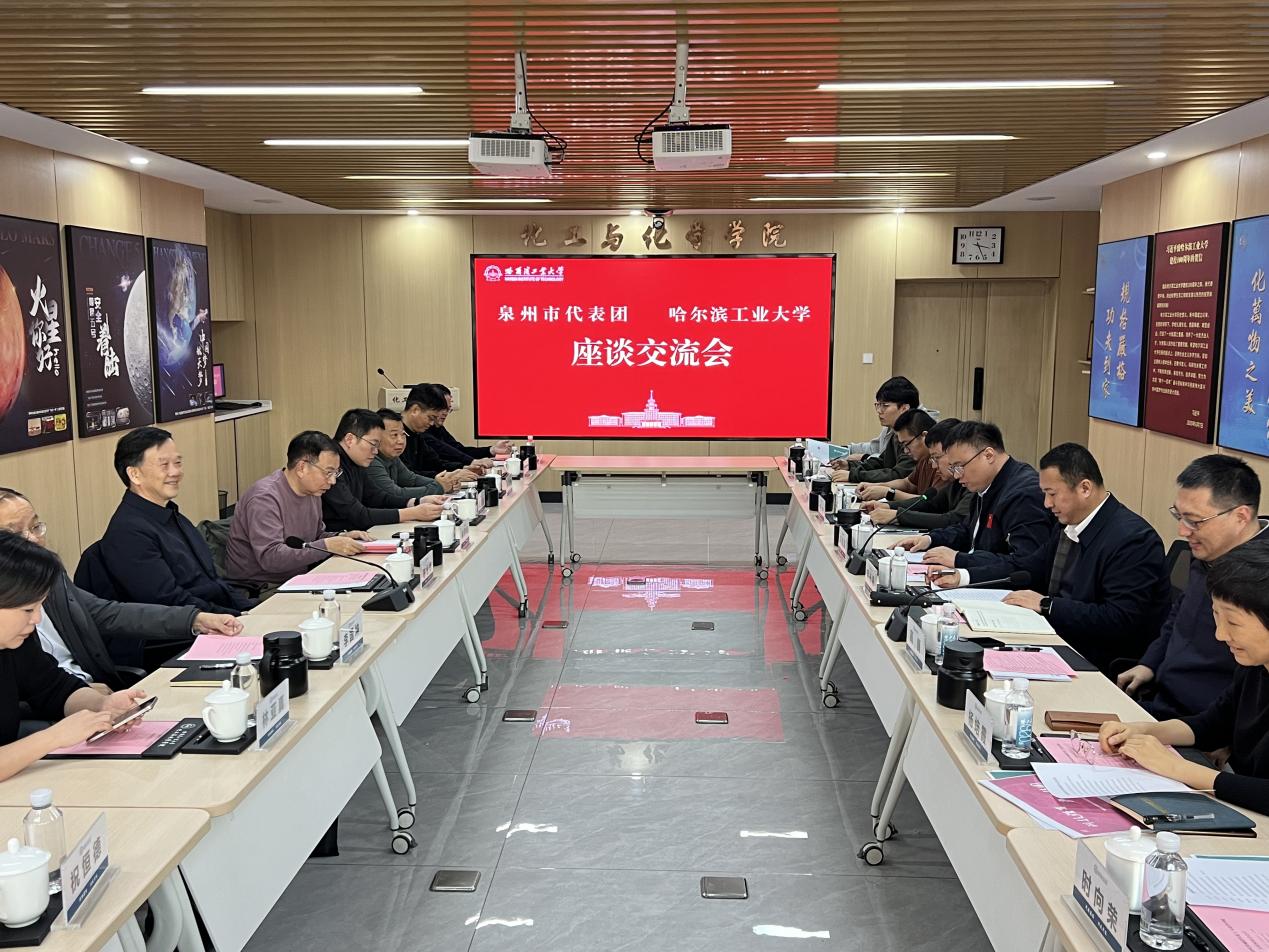
Meeting Scene