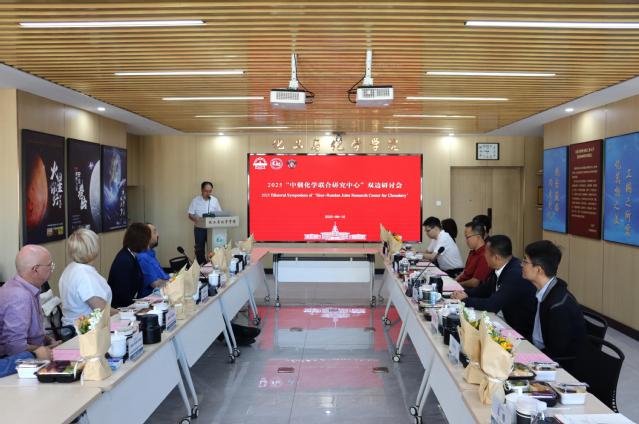
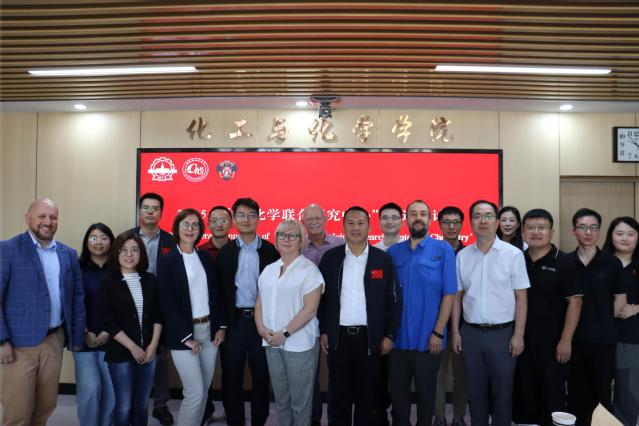
On September 10, 2025, a delegation from the Faculty of Chemistry at St. Petersburg State University (SPbU), led by Dean Prof. Irina A. Balova, visited the School of Chemistry and Chemical Engineering at Harbin Institute of Technology (HIT) at the invitation of the School. During the visit, the two sides held the 2025 bilateral symposium of the China-Russia Joint Research Center for Chemistry. Attendees from HIT included Liu Guanghui (Party Secretary of the School of Chemistry and Chemical Engineering), Hu Zhen (Vice Dean), Prof. Han Xiaojun (Director of the Department of Chemistry), and other faculty members. The symposium was held in two sessions, co-chaired respectively by Prof. Han Xiaojun and Prof. Alina Manshina from SPbU.
On behalf of the School, Liu Guanghui extended a warm welcome to the SPbU delegation. He noted that SPbU has a profound academic foundation in chemistry, and since the start of collaboration, the two sides have achieved notable phased results in talent cultivation and joint research. He pointed out that this symposium, as the first joint academic activity following the physical establishment of the China–Russia Joint Campus at HIT, marks a new stage of substantive cooperation. He expressed the hope that the two schools will use the Joint Research Center as a key platform to further deepen cooperation in talent cultivation and scientific research, explore new paradigms for the international opening of higher education, support HIT in moving its goal of advancing toward the front ranks of world-class universities, and contribute to the high-quality development of pragmatic China–Russia cooperation.
In her remarks, Prof. Alina Manshina noted that this symposium is not only a summary of past cooperation outcomes, but also a new starting point for further deepening collaboration. She expressed the expectation that it would promote substantive breakthroughs in emerging fields such as new energy materials and biomedical materials, and that cross-national exchanges of ideas would provide innovative approaches to solving complex scientific problems.
During the symposium, 12 scholars from China and Russia gave academic presentations in turn, with rich and diverse content. Participants discussed hot topics at the frontiers of chemical science and engaged in-depth exchanges on cutting-edge areas such as nanomaterials, green synthesis, and energy catalysis. The strong academic atmosphere at the venue fully demonstrated the vigorous vitality of interdisciplinary research in chemistry between China and Russia.
The School of Chemistry and Chemical Engineering will take this event as an opportunity to further improve the operation mechanism of the China-Russia Joint Research Center for Chemistry and strengthen collaborative innovation in joint research projects, high-level joint talent cultivation, and the co-construction of international academic platforms. The School will focus on strategic emerging fields such as new energy materials and biomedical materials, promote the formation of a number of high-impact flagship cooperative achievements with international influence, and strive to build a new model of international cooperation characterized by resource sharing, complementary advantages, and coordinated development. These efforts will help establish a chemistry research hub with global influence and make new and greater contributions to serving national high-level scientific and technological self-reliance and strengthening China-Russia cooperation in science, technology, and education.